


Knowing how to use gym machines for women takes the intimidation out of the weights section and gives you access to the most effective fat loss and muscle building tools available in any commercial gym. This guide covers the most important machines, how to set them up for a female body, what they actually train, and how to fit them into a progressive program that produces results.
How to Use Gym Machines for Women: Setting Up Correctly
Machine setup is where most beginners go wrong, and incorrect setup reduces both the effectiveness and safety of any exercise. Before adjusting any machine, understand what position you are trying to achieve and adjust all available settings to match your body proportions.
General setup principles for women:
- Seat height: set so the working joint (knee, hip, shoulder) aligns with the machine’s pivot point
- Back pad: positioned to support the natural curve of your spine without forcing a rounded position
- Range of motion: set to a comfortable range that avoids pain at either extreme; you can increase range as mobility improves
- Weight: start lighter than you think you need; form breaks down with ego loads on machines just as with free weights
Ask gym staff to show you the setup for any machine you are unsure about. This is part of their job and takes two minutes. A correct first setup is easier to build on than correcting a habitual wrong position.
Lower Body Gym Machines for Women
Leg Press Machine
The leg press trains the quadriceps, hamstrings, and glutes in a guided movement that is more forgiving on the lower back than a barbell squat. It is an excellent primary lower body exercise for beginners who are building confidence with loaded movement before progressing to free weights.
Setup: sit with your back flat against the pad. Place your feet shoulder-width apart on the platform, toes pointed slightly outward (30 degrees). Lower the platform by bending the knees to approximately 90 degrees, then press back to just short of full knee extension. Do not lock out the knees at the top.
High foot placement on the platform shifts emphasis toward the glutes and hamstrings. Low foot placement emphasizes the quads. Most women focused on how to use gym machines for women for glute development should use mid-to-high foot placement.
Protocol: 3-4 sets of 10-12 reps.
Leg Extension Machine
The leg extension isolates the quadriceps. It is useful as a warm-up or finisher but should not replace compound lower body exercises as the primary training stimulus. For women who want to develop the front of the thigh, it adds targeted volume after the compound work is complete.
Protocol: 3 sets of 12-15 reps. Use a controlled tempo; jerking the weight strains the knee joint.
Leg Curl Machine (Lying or Seated)
The leg curl isolates the hamstrings. The seated leg curl is generally preferred over the lying version because it pre-stretches the hamstring before the curl, producing a greater range of motion and better muscle recruitment. Strong hamstrings reduce anterior cruciate ligament (ACL) injury risk, which is significantly higher in women than men due to anatomical differences in the knee joint.
Protocol: 3 sets of 10-12 reps. Feel the hamstring working throughout the full range.
Hip Abduction Machine
The hip abduction machine trains the gluteus medius, the outer hip muscle responsible for pelvic stability during walking, running, and single-leg movements. It is one of the most useful machines specifically for women because gluteus medius weakness is the primary driver of knee valgus (knees collapsing inward) during squats, lunges, and landing from jumps.
Setup: sit with knees at 90 degrees. Adjust the pads so your thighs rest comfortably against them when the legs are together. Push outward to full range, then control the return.
Protocol: 3 sets of 15-20 reps. Do not bounce at the end range of motion.
Upper Body Gym Machines for Women
Lat Pulldown Machine
The lat pulldown trains the back muscles, primarily the latissimus dorsi. It is the machine equivalent of a pull-up and is the best machine for developing back width and pulling strength in women who cannot yet perform bodyweight pull-ups.
Setup: sit and adjust the thigh pad to hold your legs secure. Grip the bar slightly wider than shoulder-width, palms facing away. Pull the bar to your upper chest by driving your elbows down and back, squeezing your shoulder blades together at the bottom. Control the return to full arm extension before the next rep.
Protocol: 3-4 sets of 10-12 reps.
Seated Cable Row Machine
The cable row trains the mid-back and biceps through a pulling motion that directly counteracts the forward posture of desk work. This makes it one of the highest-priority machines in a women’s gym program for posture and shoulder health, not just aesthetics.
Setup: sit with knees slightly bent and a neutral spine. Grip the handle (V-bar for neutral grip or wide bar for pronated grip). Pull the handle to the lower sternum by driving the elbows back past the torso, squeezing shoulder blades together. Do not round the back to generate momentum.
Protocol: 3-4 sets of 10-12 reps. Pull to push ratio should favor the row over pressing exercises 2:1 for most desk workers.
Chest Press Machine
The machine chest press trains the pectoralis major, front deltoids, and triceps in a guided plane of motion that is easier to learn than a dumbbell or barbell press. Adjust the seat height so the handles align with the mid-chest, not the upper chest or shoulders. Press to full extension and control the return.
Protocol: 3 sets of 10-12 reps. This is a pushing exercise and should be paired with twice as many rowing sets for shoulder balance.
Shoulder Press Machine
The shoulder press machine trains the deltoids and triceps in a pressing motion overhead. It is safer than a barbell overhead press for beginners because the guided path removes the need to stabilize the bar, allowing focus on technique and muscle activation. Set the seat high enough that the handles start at shoulder height, not above it.
Protocol: 3 sets of 10-12 reps. Do not shrug the shoulders upward during the press.
Cable Machines: The Most Versatile Option
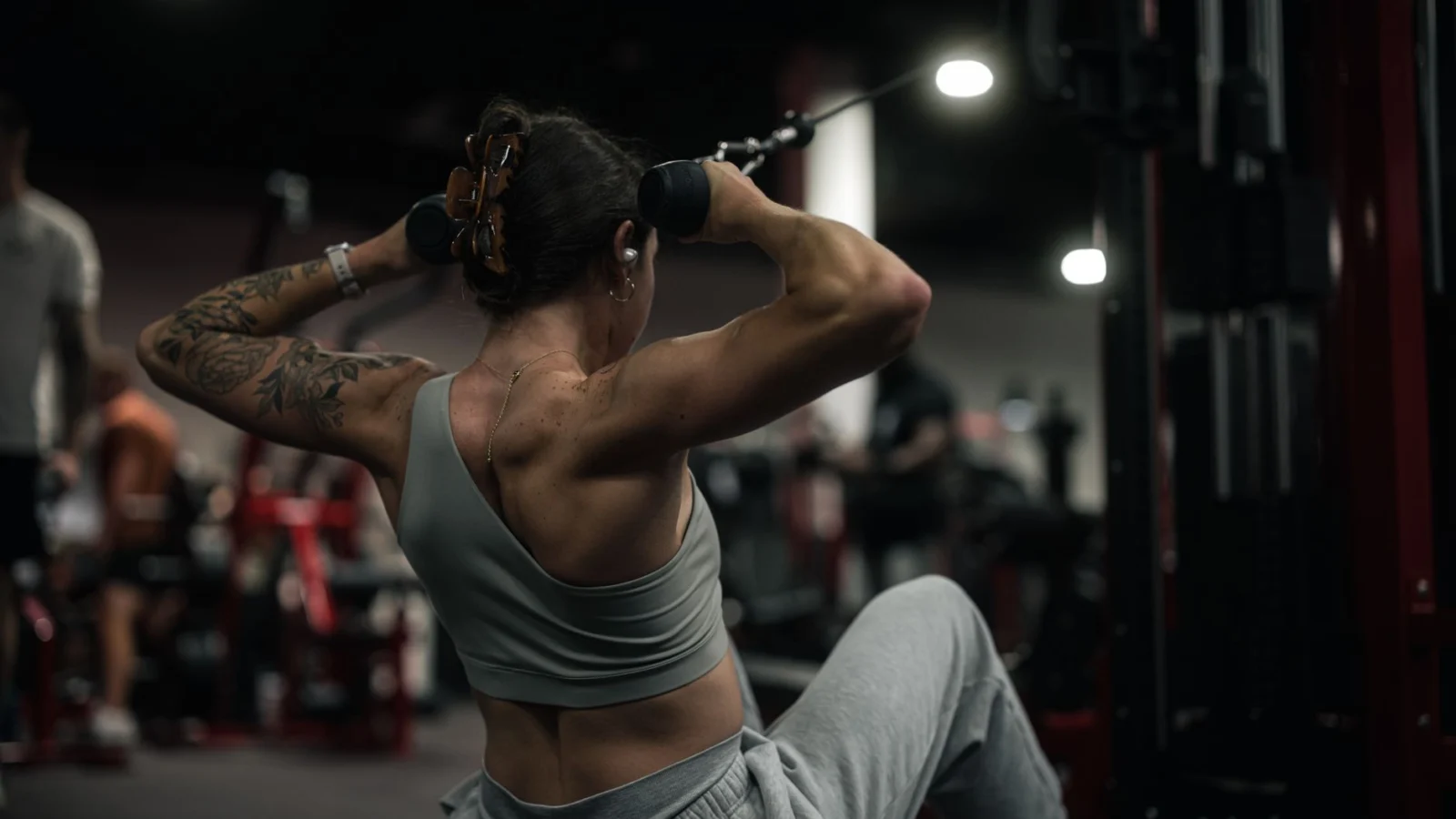
The cable machine with adjustable pulley height is the single most versatile piece of equipment in the gym. It provides constant tension through the entire range of motion (unlike free weights, which lose tension at certain points) and allows exercises in any plane of movement.
Key cable exercises for women and how to perform them:
- Cable pull-through (low pulley): stand facing away, take the rope between your legs, hinge at the hip and drive forward to standing. Trains glutes and hamstrings like a deadlift pattern with constant cable resistance.
- Face pull (high pulley): attach a rope at face height, pull toward your forehead with external rotation. Trains the rear deltoid and external rotators for shoulder health and posture.
- Cable lateral raise (low pulley): stand side-on to the pulley, raise the arm out to 90 degrees. Trains the medial deltoid for shoulder width.
- Pallof press (mid pulley): stand perpendicular to the cable, press out and return to chest. Trains core anti-rotation stability.
The cable machine is covered in depth in the upper body section of our guide to upper body workout for women at gym, which includes full session programming using cable exercises alongside free weights.
Building a Gym Machine Workout for Women
The most effective way to use gym machines for women is not to train on machines exclusively, but to combine them with free weight exercises. Machines excel at isolation, injury risk reduction, and beginners learning movement patterns. Free weights excel at full-body stabilizer recruitment and functional strength development.
A balanced gym session for women using both:
- Start with compound free weight exercises (goblet squat, dumbbell Romanian deadlift, dumbbell row) while energy and focus are highest
- Follow with machine compound exercises (leg press, lat pulldown, chest press) for additional volume in a guided pattern
- Finish with machine isolation exercises (leg curl, abduction, cable face pull) as finishers
This structure produces better results than a machine-only or free-weight-only approach for most women. The NIH research on resistance training for women supports combining both modalities for maximum muscle development and fat loss outcomes.
For the complete structured program that applies this principle across 8 weeks with progressive overload, see the gym workout plan for weight loss for women. For the underlying progression methodology, our guide on progressive overload for women beginners explains how to increase weight on both machines and free weights over time.
Common Mistakes Women Make on Gym Machines
Knowing how to use gym machines for women means knowing what not to do as much as what to do. The most common errors:
- Using momentum: swinging or jerking the weight rather than controlled muscle contraction removes the training stimulus from the target muscle and increases injury risk
- Skipping the eccentric: the return phase (lowering the weight) is equally important as the lifting phase; let the weight resist you on the way down rather than dropping it
- Wrong machine setting: failing to adjust seat height so the joint pivot aligns correctly produces joint stress rather than muscle stress
- Too much weight too soon: form breaks down with excessive load, reducing effectiveness and risking injury; progress conservatively using the double progression model
- Skipping compound movements for machines only: machine-only training produces less neuromuscular adaptation than combining machines with free weights
The CDC physical activity guidelines emphasize proper form and gradual progression in muscle-strengthening activities, which directly applies to machine use.
The machines cover the guideline’s two strength days, and the page on how to start working out shows the aerobic minutes that go around them and how to judge effort.
Frequently Asked Questions
What gym machines are best for women to lose belly fat?
No machine directly targets belly fat. The machines that produce the most systemic fat loss for women are the ones that train the largest muscle groups: leg press, lat pulldown, cable row, and cable pull-through. These compound movements produce the highest EPOC response and build the most metabolically active muscle tissue per session. Abdominal machines like the crunch or ab roller have minimal impact on belly fat compared to lower body and back machines.
Should women use weight machines or free weights?
Both. Machines provide a guided path that reduces injury risk and allows beginners to focus on muscle activation without coordination demands. Free weights recruit more stabilizer muscles and produce greater neuromuscular adaptation. The most effective approach is to use compound free weight exercises as the foundation and machines as supplementary volume and isolation tools.
Which machines should women avoid?
No machine is inherently dangerous if set up correctly and used with appropriate weight. Machines that are most commonly misused and produce poor results when treated as primary exercises include the abdominal crunch machine (low calorie burn, no fat loss benefit), the inner thigh machine when used at extreme ranges of motion (joint stress), and the Smith machine for squats when it locks the bar into a vertical path that forces an unnatural knee angle. Use these machines judiciously rather than avoiding them entirely.
How much weight should a woman beginner use on gym machines?
Start with a weight where you can complete all target reps with good form and feel the target muscle working, but where the last two to three reps require effort. On most machines, this will be lighter than you expect on the first session. Use the first session as a calibration session: find the correct weight for each machine and record it. Build from that baseline using the double progression model (add reps first, then weight) described in our guide on progressive overload for women beginners.
Conclusion
Learning how to use gym machines for women correctly opens up the majority of training tools available in any commercial gym and removes the uncertainty that keeps many women limited to cardio equipment. The leg press, lat pulldown, seated cable row, hip abduction machine, and cable machine cover all major muscle groups and produce significant fat loss and strength results when used with progressive overload.
Set up each machine correctly, start lighter than your ego suggests, train the target muscle through the full range of motion with controlled tempo, and apply the same progressive overload principles that govern all effective resistance training. The gym floor becomes significantly less intimidating once you know what each machine does, how to set it, and where it fits in your program.
Medical disclaimer: This article is for informational purposes only and does not constitute medical advice. Consult a qualified healthcare provider before beginning any new exercise program, particularly if you have existing health conditions.
Related Articles
- Upper Body Workout for Women at Gym: The Essential Guide
- Gym Workout Plan for Weight Loss for Women: The 8-Week Guide
- Beginner Gym Routine for Women: The 4-Week Plan That Actually Works


