

Search middle back pain stretching exercises and you get the same eight moves on every page, presented as though they will fix your posture. They are worth doing. They will not do that, and the research saying so is stronger than the research behind the claim.
What middle back pain usually is
The middle back is the thoracic spine, the twelve vertebrae your ribs attach to. It is built for stability rather than movement, which is why it tends to stiffen rather than give way, and why the pain is usually a dull ache between or just below the shoulder blades rather than the sharp travelling pain people get lower down.
The common drivers are hours at a desk with the shoulders rounded forward, carrying loads on one side, and a simple lack of rotation in daily life. If your pain instead runs down a leg, or sits low and to one side, that is a different problem, and our guide to what causes lower back pain in women covers it properly.
The middle back pain stretching exercises worth doing
These target rotation and extension, the two movements the thoracic spine loses first. Hold each for about 30 seconds, two or three rounds, and stop at tension rather than pain.
Thread the needle
On hands and knees, slide one arm underneath your body and across, letting the shoulder and the side of your head rest toward the floor. This is rotation, the movement a desk takes away fastest.
Open book
Lie on your side, knees bent in front of you, arms stretched out together. Keeping the knees down, open the top arm across your body and follow it with your eyes. Rotation again, with the lower back held still so the movement happens where you want it.
Foam roller extension
Lie back over a foam roller placed across the mid back, support your head with your hands, and ease backward over it. Work a few centimetres at a time rather than rolling the whole length at once.
Cat and cow
On hands and knees, alternate arching and rounding. The point is moving the thoracic segments one at a time, not getting the biggest possible range.
Doorway chest stretch
Forearm on the door frame, elbow at shoulder height, step through. Tight chest muscles pull the shoulders forward and the mid back takes the strain.
What these stretches will not do

Almost every page on middle back pain stretching exercises promises better posture. A 2024 systematic review and meta-analysis in Sports Medicine Open pooled 23 controlled trials with 969 participants and tested that claim directly.
Stretching had no measurable effect on posture. Not in the short term, where the effect size was 0.01 with a p value of 0.97, and not with sustained practice, where it was minus 0.19 and still not significant. Strengthening produced large improvements, and beat stretching head to head.
The detail that matters most: strengthening worked specifically in the thoracic and cervical spine, at an effect size of minus 1.04, and did not work in the lower back. So for the middle back, which is what you are asking about, strengthening is the part with evidence behind it. The authors graded the certainty as moderate and concluded that the evidence does not support stretching as a treatment for muscle imbalance.
That does not make stretching pointless. It eases the sensation of tightness and it feels good, and both are fair reasons to do it. It will not reshape how you stand.
What actually changes the middle back
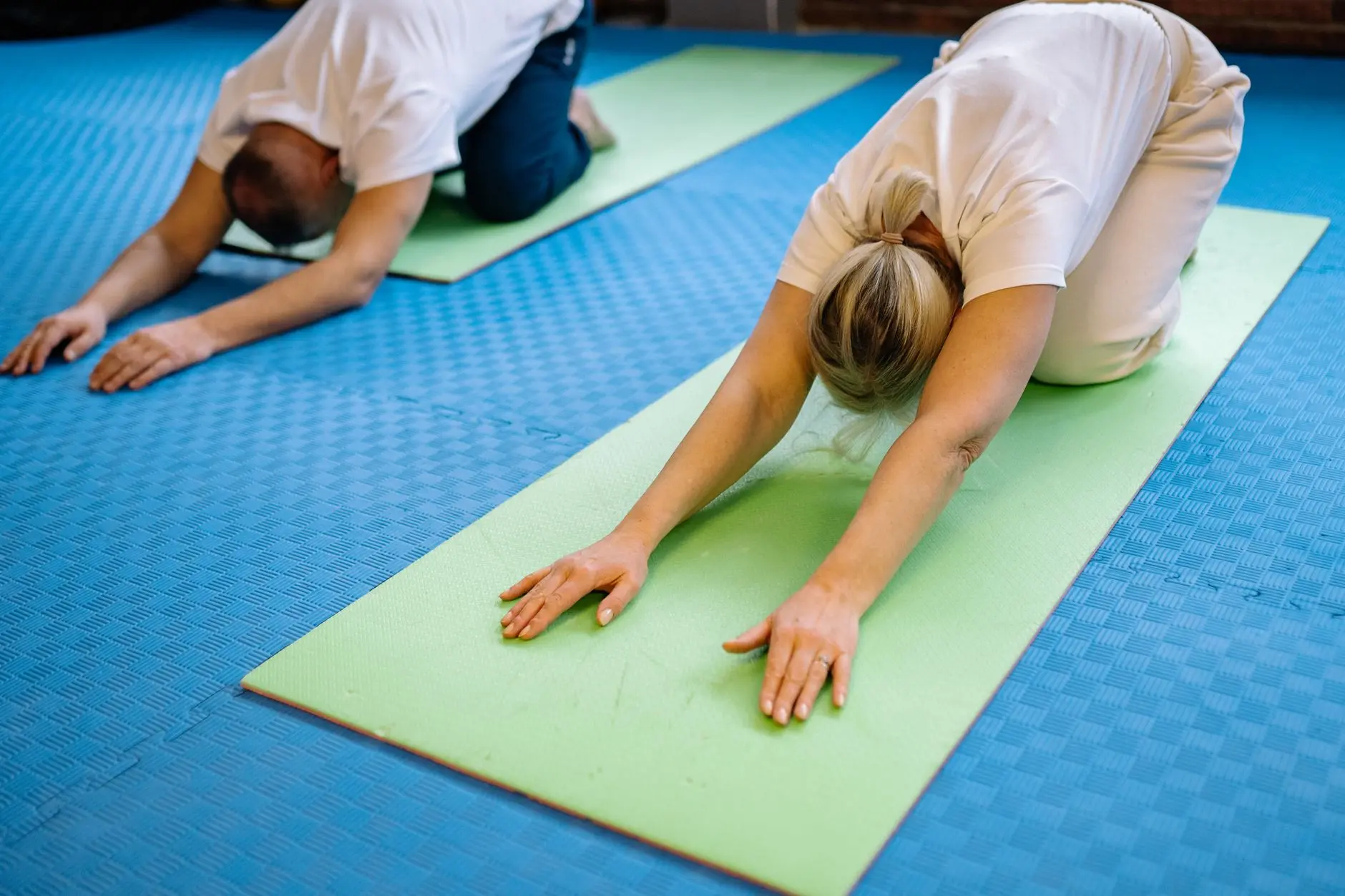
Rows, face pulls, prone Y and T raises, and anything that trains the muscles between the shoulder blades to hold position under load. Twice a week is enough to start, and the same movements carry over to the neck and shoulders because the thoracic spine sits underneath both.
For a structured place to begin, our strength training routines for women over 50 cover the pulling movements that matter here. Pair them with the stretches rather than choosing between them.
How to progress it, since this is where most people stall: start with two sets of ten on each movement, using a weight that is genuinely hard by the last two repetitions. Add either a repetition or a small amount of load each week. The muscles between the shoulder blades are postural endurance muscles, so they respond to being asked to hold a position for longer rather than to heavier single efforts. Holding the top of a row for two seconds before lowering is worth more than adding weight you cannot control.
Why the thoracic spine stiffens in the first place
Each of those twelve vertebrae connects to a pair of ribs, and that ring of bone is what makes the middle back stable and also what limits it. The joints there are angled for rotation rather than bending, so rotation is the movement you lose first and the one worth protecting.
Breathing matters more here than anywhere else in the spine. Shallow upper-chest breathing, which is what most people default to at a desk or under stress, keeps the ribs held high and the thoracic spine held still. Slow breathing into the lower ribs restores some of that movement without any exercise at all. It is the cheapest thing on this page: a few minutes of breathing out for longer than you breathe in, with a hand on the lower ribs to feel them widen.
This is also why mid back pain so often arrives alongside neck or shoulder trouble. When the thoracic spine stops rotating and extending, the segments above and below take up the slack and get overworked.
The desk setup that produces most of this
Screen height is the one worth fixing first. A screen below eye level pulls the head forward, and the mid back rounds to follow it. The top of the screen should sit at or just below eye level, which usually means raising a laptop and using a separate keyboard.
Then the forearms. If they are unsupported, the shoulders creep up and forward and the muscles between the blades spend the day lengthened under load, which is exactly the state that registers as tightness. Chair arms or the desk should take that weight.
Neither fix removes the need to move. Position tolerance is measured in minutes, not hours, and the most effective intervention available to you is standing up more often than you think is necessary.
The warning that belongs on every stretching article and almost never is
If you have osteoporosis, or have been told your bone density is low, forward-bending stretches are not neutral for you.
A study of 59 postmenopausal women with spinal osteoporosis in Archives of Physical Medicine and Rehabilitation followed four groups for one to six years. New vertebral wedging or compression fractures occurred in 16% of the women doing extension exercises, 53% of those doing both flexion and extension, and 89% of those doing flexion exercises alone. Among women doing no therapeutic exercise at all, it was 67%.
Read that again. The flexion group fractured more than the group doing nothing. The difference against extension was significant at p below 0.001.
It is one study, it is from 1984, and the flexion group was small at nine women. It has nonetheless shaped clinical advice for forty years because the size of the difference is hard to explain away. The practical rule: if your bone density is low, favour extension and isometric work, and clear repeated loaded forward bending with a doctor first.
When middle back pain stretching exercises are the wrong answer
Stretching helps muscular, position-driven, stiffness-type pain. It does nothing for the causes below, and reaching for it can delay the thing that would help.
Pain that wraps around the ribs toward the front, pain that is worse at night or wakes you, pain with fever, pain after a fall, new numbness or weakness, and unexplained weight loss alongside the pain all need assessing rather than stretching. So does mid back pain that arrives suddenly and severely in someone with known osteoporosis, because that pattern can be a compression fracture.
Our back pain guides cover the other presentations in more detail, and sciatica stretch exercises is the right page if the pain travels into a leg.
A week that fits together
Two strengthening sessions, because that is where the evidence sits. The stretches daily or near enough, because they cost little and relieve the tight feeling. Movement breaks through the day, because the thoracic spine stiffens with sustained position more than with effort, and standing up every half hour does more than one long session makes up for. If you want those short walks to count toward something you can see, our steps to calories calculator turns a day of them into a number.
Then give it six to eight weeks before judging it. If middle back pain stretching exercises and strength work together have changed nothing in that time, the problem is probably not the one you have been treating, and that is worth an assessment rather than more repetitions.
What to expect along the way
Stretching usually feels better immediately and the effect fades within hours. That is normal and not a sign you are doing it wrong. Strength changes take weeks and hold for longer, which is the trade.
If a stretch produces sharp pain, pain that travels, or pain that lingers after you stop, drop that one. Tension that eases as you hold is the sensation you are looking for.
Frequently asked questions
Do middle back pain stretching exercises fix posture?
No, and the evidence against it is reasonably strong. A 2024 meta-analysis in Sports Medicine Open pooling 23 trials and 969 participants found stretching had no measurable effect on spinal posture, either acutely or with sustained practice. Strengthening produced large improvements and worked specifically in the thoracic spine. Stretching still relieves the feeling of tightness, which is a fair reason to do it, but it will not change how you stand.
How often should I do them?
Daily or close to it is fine, holding each position around 30 seconds for two or three rounds. They are low cost and low risk for most people. The more important commitment is two strengthening sessions a week aimed at the muscles between the shoulder blades, because that is the part with evidence behind it for the middle back.
Are these stretches safe if I have osteoporosis?
Forward-bending ones may not be. A study of 59 postmenopausal women with spinal osteoporosis found new vertebral fractures in 89% of those doing flexion exercises, against 16% doing extension exercises and 67% doing no therapeutic exercise at all. If your bone density is low, favour extension and isometric work, and clear repeated loaded forward bending with a doctor first.
Why does my middle back feel tight even though I stretch it?
Because tightness in the thoracic spine is usually a strength and position problem rather than a length problem. The muscles between your shoulder blades are holding a load they are not conditioned for, and that registers as tightness. Stretching relieves the sensation for a few hours; strengthening addresses what is producing it.
When should I see a doctor instead?
If the pain wraps around your ribs to the front, is worse at night or wakes you, comes with fever, follows a fall, involves numbness or weakness, or sits alongside unexplained weight loss. Sudden severe mid back pain in someone with known osteoporosis also needs assessing, because it can be a compression fracture rather than muscular pain.
Sources
- Effects of Stretching or Strengthening Exercise on Spinal and Lumbopelvic Posture: A Systematic Review with Meta-Analysis. Sports Medicine – Open, 2024
- Postmenopausal spinal osteoporosis: flexion versus extension exercises. Archives of Physical Medicine and Rehabilitation, 1984
This article is general health information for adults and not medical advice. It does not know your history, your medication or your results. For a decision about your own health, talk to a doctor or another qualified clinician who does.