

If you are asking what is the cause of lower back pain in women, the honest answer is that there are several, they feel different from each other, and the useful skill is telling them apart. Most articles on this name the same causes and stop. This one gives the numbers behind each, and is straight about where the evidence is weak.
Pain in the middle of the back behaves differently from lower back pain, and our guide to middle back pain stretching exercises covers the thoracic spine specifically, including which movements to avoid if your bone density is low.
Start here: the symptoms that mean stop reading
Go to an emergency department now if you have numbness in the area that would touch a saddle, meaning the inner thighs, buttocks and groin, or if you lose control of your bladder or bowels, or if both legs become weak.
That combination can indicate cauda equina syndrome, where the nerve roots at the base of the spine are compressed. A 2023 systematic review in PLoS One covering 110 studies and 52,008 patients found the field still disagrees on the exact definition and on how quickly surgery must happen, which is exactly why it is not something to wait out at home. It is rare, and it is the one back problem where hours matter.
Most published warning signs do not work, and that is worth knowing
Every article asking what is the cause of lower back pain in women gives you a list of red flags. A 2023 Cochrane review of 14 studies tested how well those red flags actually identify a vertebral fracture. The finding is blunt: most of them were not useful as screening tools.
Only a few carried real information. In primary care, older age was informative for an unspecified vertebral fracture, and trauma and corticosteroid use were informative for both unspecified and osteoporotic fractures. Combinations of signs were more useful than any single sign alone.
What to do with that: treat a long list of warning signs as a prompt to get assessed, not as a test you can run on yourself. One item on a list is weak evidence. Several together, or any of the emergency symptoms above, is a reason to be seen.
The menopause transition, the cause most lists leave out
Search this subject and you will find endometriosis, periods and pregnancy covered everywhere, and perimenopause barely mentioned. That gap is hard to justify given the size of the effect.
A 2026 systematic review and meta-analysis in JB and JS Open Access pooled 37 studies across 22 countries covering 93,021 women. Muscle or joint pain affected 40% of premenopausal women, 57% of perimenopausal women and 59% of postmenopausal women. That is a 1.35 times higher risk during perimenopause, or 130 more women in every 1,000 compared with before the transition.
Be straight about the limits, because the authors are. These are observational studies, heterogeneity between them was high, and the review concludes that the specific causes are underreported and better research is needed. So the association is solid and the mechanism is not pinned down. It is still a far stronger basis than the silence most articles offer.
What it tends to feel like: stiffness worst in the first half hour after waking that eases as you move, with aching that is diffuse rather than pinned to one spot. If your back pain arrived in your forties alongside changes to your cycle, sleep or temperature, this belongs on your list.
Weight, with the actual effect size
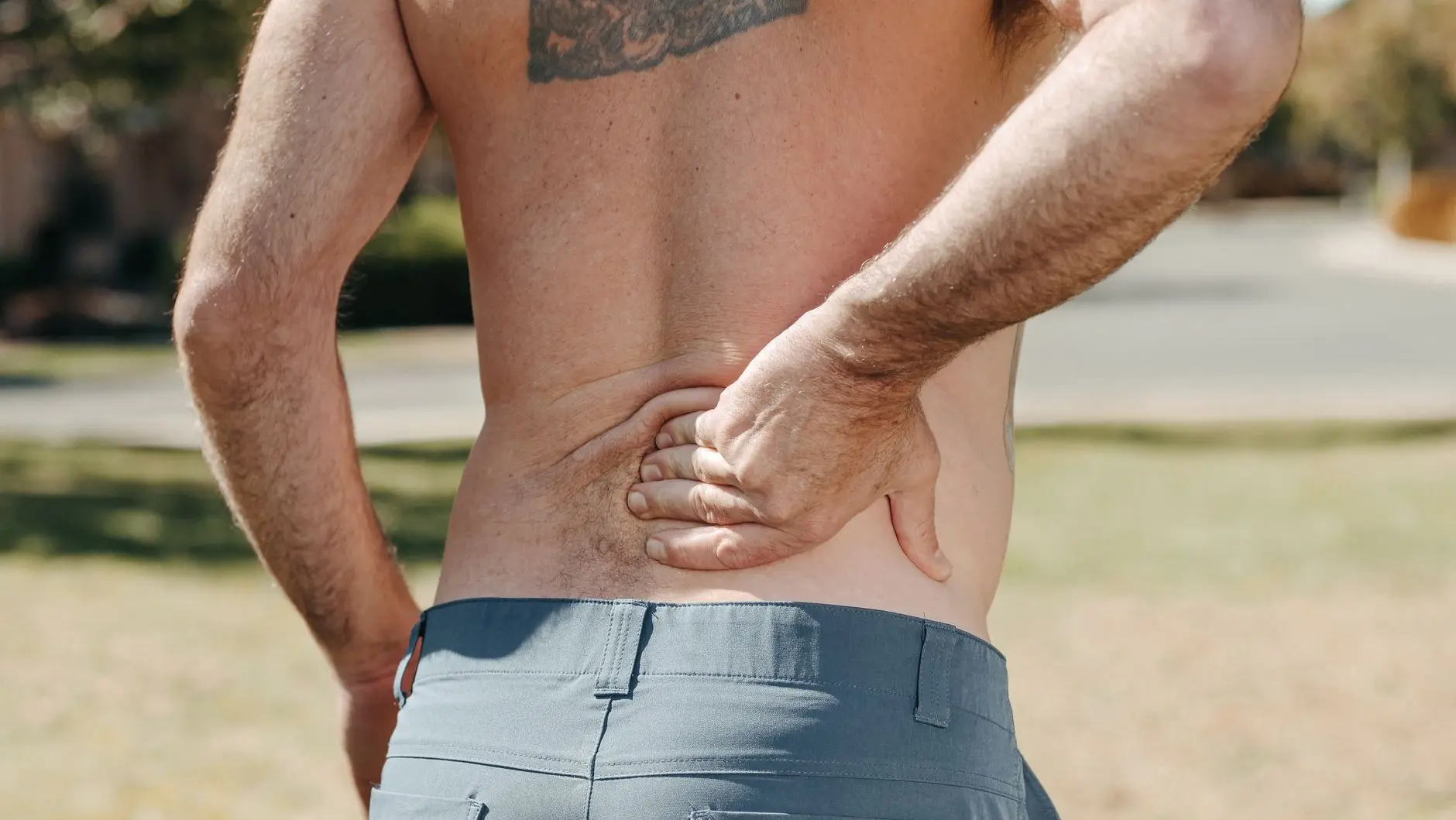
This cause gets asserted constantly and quantified almost never. A meta-analysis in the American Journal of Epidemiology reviewed 95 studies and pooled 33. Obesity was associated with low back pain in the previous 12 months at an odds ratio of 1.33, and with seeking care for back pain at 1.56.
Read the size properly. An odds ratio of 1.33 is a real association and a modest one. It is not the dominant explanation for most people’s back pain, and anyone promising that losing weight will fix your back is overselling it. The association is stronger for chronic pain and for seeking care than for occasional pain.
If you want your own number, our BMI calculator gives it, with the usual caveat that it says nothing about muscle mass or where you carry weight.
Pregnancy and the postpartum year
Back pain in pregnancy is usually explained by two things at once: relaxin loosening the ligaments that stabilise the pelvis, and a shifting centre of gravity changing how you stand.
What gets less attention is how long it persists afterwards. Back pain during the pregnancy itself is among the strongest predictors of still having it months after the birth, so it often does not resolve on the schedule people expect.
Abdominal separation matters here too. If the abdominal wall has not knitted back together, the muscles that normally share load with the spine are not doing their part, and the back compensates.
Stress, which is a mechanism and not a dismissal
Being told your back pain is stress feels like being told it is imaginary. It is not the same claim. Sustained stress keeps muscles in low-level contraction, and those along the spine and across the shoulders are among the first to hold it. Held long enough, that is real pain in genuinely tight tissue.
It also runs both ways, which is why it becomes a loop. Pain disrupts sleep, poor sleep lowers pain tolerance the next day, and lower tolerance makes the same tension hurt more.
How to recognise it: pain that tracks your workload rather than your activity, eases on holiday, and sits across the upper back and neck as much as the lower back.
Shift work and the hours you keep
If you work nights, that belongs on the list as a cause in its own right. Night work combines three aggravating factors: long periods standing or sitting without variation, sleep taken at the wrong point in the body clock and usually in shorter blocks, and meals at hours when digestion is slower.
The broken daytime sleep matters most, because muscle repair and pain threshold both depend on it. Our guide to lower back pain while sleeping covers positions and support, and the day-sleep setup, meaning darkness, temperature and interruptions, deserves as much attention as the mattress.
The ordinary causes that are still the most likely
Women also get back pain for the reasons everyone does, and these remain the most common by a distance: muscle and ligament strain from lifting or twisting, long hours seated with the pelvis tipped back, weak deep abdominal and gluteal muscles leaving the spine to work alone, and disc and joint changes that become more common with age.
So asking what is the cause of lower back pain in women should not push the ordinary explanations down the list. It should add the female-specific ones that generic advice misses. Both sets are usually live at once.
Our guides to sitting positions for lower back pain and morning stretches for easing lower back pain cover the two situations that produce the most complaints.
What is the cause of lower back pain in women in your case? Four questions
When did it start, and what else started then? Pain beginning with cycle changes in your forties points one way, pain beginning after a birth another, and pain beginning when your job changed points to load and hours.
What makes it better or worse? Easing with movement and worsening with stillness suggests stiffness and tension. Worsening with specific movements and easing with rest suggests a mechanical cause. Tracking your stress rather than your activity suggests the tension loop.
Where exactly is it? Diffuse aching across the lower back behaves differently from pain running down one leg, which suggests nerve involvement and is worth assessing sooner.
Does it follow your cycle? If it is reliably worse at particular points each month, raise that with a doctor, because cycle-linked causes are among the most commonly missed in women.
What helps across almost all of these
Whatever the answer to what is the cause of lower back pain in women turned out to be for you, movement beats rest for nearly every cause above. Extended bed rest makes most back pain worse, because deconditioned muscles support the spine less well each day.
Strength work on the deep abdominal muscles, glutes and the muscles along the spine has the broadest benefit, and it helps whether the driver is hormonal, postural or load related. Walking is the simplest start, and our piece on interval walking for back pain covers a structured version with trial evidence behind it.
Sleep is the lever people underrate. If pain is disturbing sleep, treating the sleep problem is part of treating the back problem, not a distraction from it. More options in our back pain guides.
When to stop self-managing
See a doctor if pain has not improved at all after six weeks of sensible self-care, if it is worsening rather than settling, if it wakes you at night, if there is numbness or weakness in a leg, or if it follows a fall. Given what the Cochrane review found, do not try to rule yourself out using a checklist. The list tells you when to ask, not whether you are fine.
In the first year after giving birth, treat new or severe symptoms with less patience rather than more. The CDC’s Hear Her campaign exists because postpartum warning signs are so often dismissed, including by the women experiencing them.
Asking what is the cause of lower back pain in women is the right question, and the answer is usually more than one thing at once: something that made the back vulnerable, plus a load or habit that triggered it. Treating only one half is why so many people get partial relief and stall there.
Frequently asked questions
What is the cause of lower back pain in women most often?
The most common causes are the same ones that affect everyone: muscle and ligament strain, prolonged sitting, and weak core and gluteal muscles. What differs is the extra set of female-specific drivers layered on top, including the perimenopausal rise in musculoskeletal pain, pregnancy and the postpartum period, and cycle-linked conditions. Most women with persistent back pain have more than one contributing cause at once.
Can perimenopause cause lower back pain?
Yes, and it is the cause most often left out. A 2026 systematic review and meta-analysis of 93,021 women found muscle or joint pain in 40% of premenopausal women, 57% of perimenopausal women and 59% of postmenopausal women, a 1.35 times higher risk during the transition. The authors note the studies are observational with high heterogeneity, so the association is clear while the mechanism is not settled.
Does losing weight fix back pain?
It helps some people, and by less than is usually claimed. A meta-analysis in the American Journal of Epidemiology pooling 33 studies found obesity associated with low back pain in the previous 12 months at an odds ratio of 1.33, and with seeking care at 1.56. That is real but modest, so weight is one contributing factor rather than the whole explanation for most people.
Are the usual back pain red flags reliable?
Mostly not, which is rarely mentioned. A 2023 Cochrane review of 14 studies found most red flags were not useful as screening tools for vertebral fracture. Only a few carried real information, including older age, trauma and corticosteroid use in primary care, and combinations performed better than single signs. Use the lists to decide when to ask for an assessment, not to rule yourself out.
When is lower back pain an emergency?
Go to an emergency department immediately if you have numbness across the inner thighs, buttocks or groin, loss of bladder or bowel control, or weakness in both legs. That combination can indicate cauda equina syndrome, where hours matter. Arrange an appointment within days for back pain with fever, pain after a fall, pain that wakes you at night, unexplained weight loss, or leg weakness that is getting worse.
Sources
- Musculoskeletal Manifestations of Perimenopause: A Systematic Review and Meta-Analysis of 93,021 Women. JB & JS Open Access, 2026
- Red flags to screen for vertebral fracture in people presenting with low back pain. Cochrane Database of Systematic Reviews, 2023
- The association between obesity and low back pain: a meta-analysis. American Journal of Epidemiology, 2010
- Definition and surgical timing in cauda equina syndrome: an updated systematic review. PLoS One, 2023
- Hear Her Campaign: Urgent Maternal Warning Signs. Centers for Disease Control and Prevention, 2024
This article is general health information for adults and not medical advice. It does not know your history, your medication or your results. For a decision about your own health, talk to a doctor or another qualified clinician who does.