


Lifting heavy in perimenopause is one of the few things you can do that speaks directly to what your skeleton is going through in your forties. Estrogen is not only a reproductive hormone. It is one of the main brakes on bone turnover, and when it starts swinging and then falling, that brake comes off. What follows is a stretch of accelerated bone loss that begins earlier than most women are told and largely ends before most women are ever offered a bone scan.
For the years after the transition finishes, our strength training routines for women over 50 cover the postmenopausal protocol and the fracture evidence behind it.
The fitness internet has settled on a slogan for this: lift heavy. The slogan is not wrong. It just skips the three parts that actually decide whether it works for you, which are when the window opens, what the word “heavy” means to a bone as opposed to a muscle, and what the research honestly does and does not show. This article covers all three, including the limits, because the limits are where most articles on lifting heavy in perimenopause quietly stop being useful.
Why Lifting Heavy in Perimenopause Is Different From Lifting at 30
At 30, resistance training is mostly a muscle and metabolism story. Bone is in a steady state. You are not losing much, and the loading you do is maintenance rather than rescue.
Perimenopause changes the assignment. Falling estrogen speeds up the cells that break bone down while the cells that rebuild it fall behind. The gap between those two processes is what shows up on a scan years later as osteopenia or osteoporosis. Nothing about that gap is visible, and nothing about it hurts. Bone loss has no symptoms until something breaks.
That is why lifting heavy in perimenopause is a different proposition than lifting in your twenties. You are no longer training on top of a stable skeleton. You are training against an active drawdown. The same set of squats has a different job now.
Mayo Clinic Healthcare women’s health specialists describe perimenopause and the years after menopause as the point where building skeletal health becomes especially important, and identify weight-resistance exercise as central to that. Their framing is worth repeating because it is more measured than the slogan version: it is about resistance, and you build it up gradually. That gradual build is the part of lifting heavy in perimenopause that the social media version of this advice tends to skip.
The Bone Loss Window You Cannot See While You Are Inside It

This is the part almost every article on lifting heavy in perimenopause leaves out, and it changes the timing of the whole decision.
Researchers following 629 women with annual bone measurements over 15 years mapped bone loss against the final menstrual period rather than against age. More than two years before that final period, spine bone loss ran at about 0.2% per year, a rate the researchers noted was not statistically different from no loss at all. In the two-year window immediately before the final period, it jumped to roughly 1.7% per year. Loss stayed fast for about two years afterward before settling to around 1% per year.
Read that sequence again, because there is a trap inside it. The fastest loss starts before your periods stop. And a final menstrual period can only be identified in hindsight, after twelve consecutive months without one. So the two-year stretch of steepest bone loss is a window you can only confirm you were in roughly three years after it opened.
You cannot test your way into catching it. You cannot wait for a symptom, because there is not one. The only workable response to a window you cannot see is to already be loading your skeleton before it opens, which in practice means starting in your early or middle forties rather than waiting for a diagnosis. That is the honest case for lifting heavy in perimenopause, and it is a timing argument rather than a motivational one.
What “Heavy” Actually Means to a Bone
Muscle and bone respond to different signals, and conflating the two is why a lot of well-intentioned exercise does very little for the skeleton.
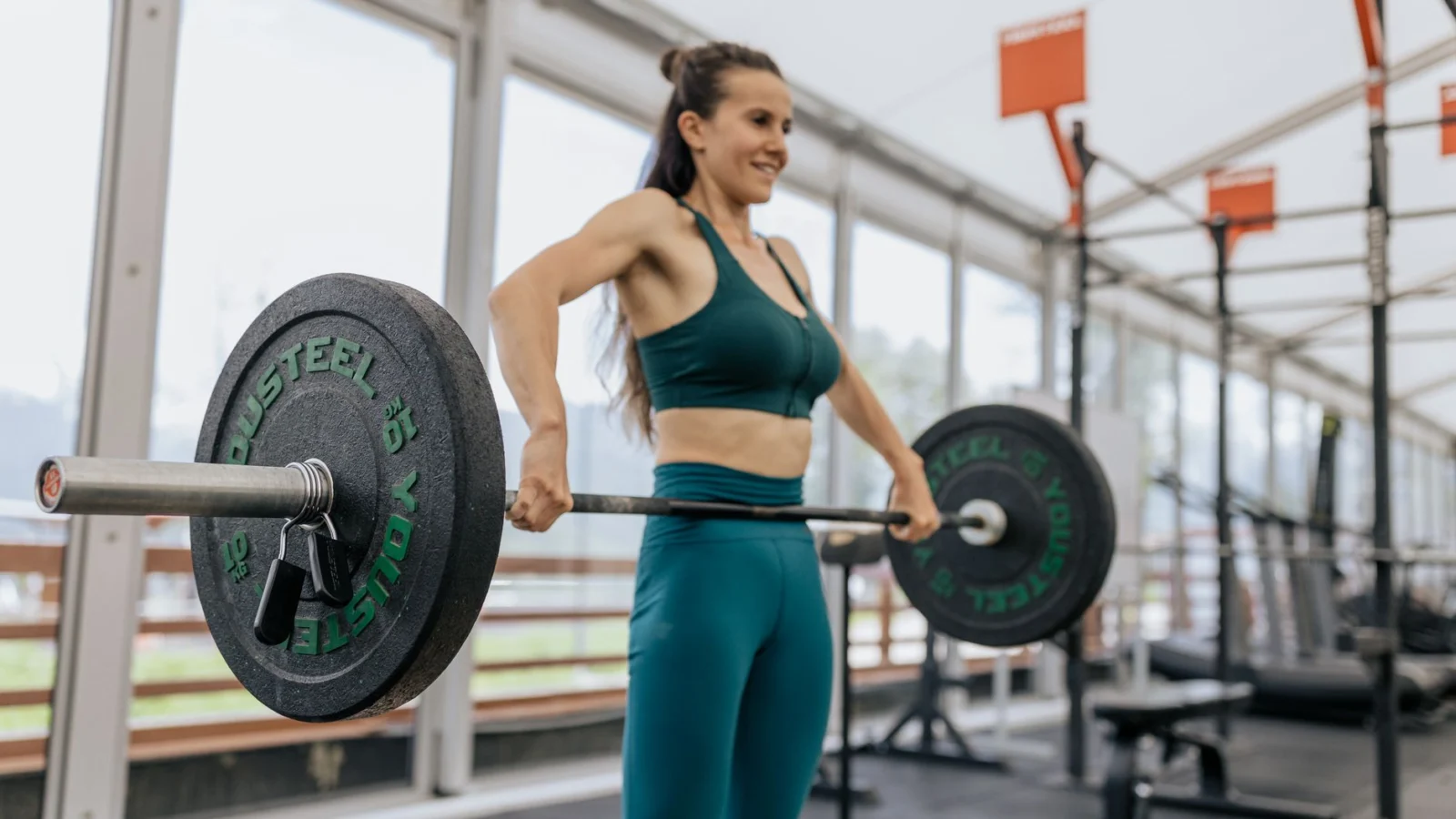
Muscle grows in response to accumulated mechanical tension and volume. You can build muscle with moderate weights and higher repetitions taken close to failure. Bone does not work that way. Bone adapts to the peak size of the strain and how fast that strain is applied. The researchers behind the best-known trial in this area put it plainly: optimal bone-building loading requires high-magnitude strains applied at high rates.
Two consequences follow for anyone considering lifting heavy in perimenopause, and both contradict standard advice given to women in midlife.
First, duration does not substitute for magnitude. Walking is genuinely good for cardiovascular health, mood, and joints, but the peak forces involved sit below the threshold that prompts bone to reinforce itself. Ninety minutes of walking does not become a bone stimulus by being long. It is the wrong signal repeated.
The same logic applies inside the gym. New lifters often assume they should stay light for safety, then stay light for years. Light weights for high reps are a muscular-endurance stimulus. They are close to invisible to bone.
Second, bone adaptation is site-specific. Loading the spine and hips improves the spine and hips. It does nothing measurable for a wrist you never load. That is why compound lifts that put force through the trunk and pelvis, the squat, the deadlift, the overhead press, keep appearing in the research, while machine isolation work does not. If you are still working out how to add load systematically, our guide to progressive overload for women beginners covers the mechanics of getting from light to genuinely heavy without guessing.
What the LIFTMOR Trial Actually Found
Nearly every article recommending lifting heavy in perimenopause leans on one study, so it is worth reading that study properly rather than through a headline.
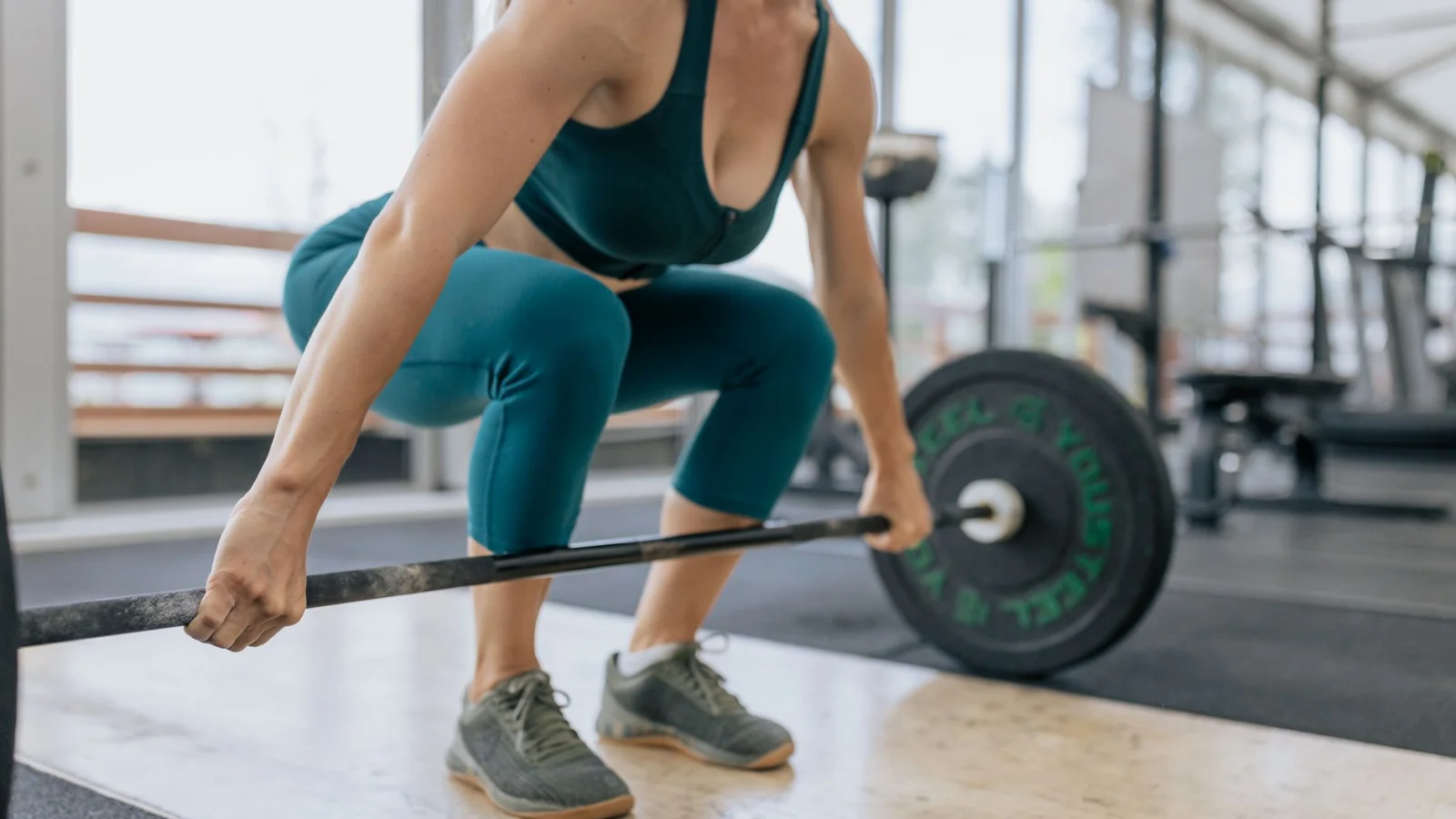
The LIFTMOR randomized controlled trial took 101 postmenopausal women with low bone mass and split them between eight months of supervised high-intensity resistance and impact training, twice a week for 30 minutes, and a home-based low-intensity program. The training group did five sets of five repetitions above 85% of a one-repetition maximum. That is genuinely heavy.
The results: lumbar spine bone density rose 2.9% in the training group while falling 1.2% in the low-intensity comparison group. Femoral neck density rose 0.3% against a 1.9% decline. Cortical thickness at the femoral neck improved. The training group gained 0.2 cm in height while the comparison group lost 0.2 cm. Across the full eight months, with compliance in the training group averaging 92%, exactly one adverse event was reported: a minor lower back spasm.
That last detail matters, because these were women who had specifically been told for decades that heavy loading would fracture them. The trial authors noted the finding ran contrary to prevailing opinion.
Now the caveats that almost never travel with the headline. The women in LIFTMOR averaged 65 years old and already had low bone mass. They were postmenopausal, not perimenopausal. The training was closely supervised by people who knew how to teach a deadlift. None of that makes the trial irrelevant to a 46-year-old, but it does mean the direct evidence for lifting heavy in perimenopause specifically is thinner than the confident tone of most articles suggests. We are extrapolating from a nearby population, and it is more honest to say so.
What Lifting Heavy in Perimenopause Cannot Do
The gap between “this helps” and “this fixes it” is wide, and overstating it does real harm on a topic where the downside is a fractured hip at 70.
A systematic review pooling 80 exercise trials and 5,581 postmenopausal women found a consistent positive effect of exercise on bone density at the spine, femoral neck, and total hip. The effect sizes were small to moderate rather than dramatic. That is the realistic picture: training meaningfully slows and partially offsets bone loss. It does not rebuild a skeleton to what it was at 25.
Three specific limits are worth stating outright.
Lifting is not a replacement for medical treatment. If you have been diagnosed with osteoporosis or have already had a fragility fracture, exercise sits alongside whatever your clinician recommends, not instead of it. Decisions about bone medication or hormone therapy belong with your doctor, who can weigh your fracture risk, your history, and your scan results in a way no article can.
Lifting does not override nutrition. Bone is built from material you have to supply. Adequate protein, calcium, and vitamin D are the raw inputs, and training without them is asking for construction with no delivery of bricks. Your clinician can tell you whether your intake or vitamin D status needs attention.
Lifting does not undo years of nothing overnight. Bone remodels on a cycle measured in months. LIFTMOR ran eight months to produce a 2.9% spine change. This is a multi-year commitment or it is not worth starting, which is the real reason consistency matters more here than intensity does. If keeping the habit is your actual sticking point rather than the programming, our piece on building a gym habit that sticks is a better use of your next twenty minutes than another article about sets and reps.
How to Start Lifting Heavy in Perimenopause Without Getting Hurt
“Heavy” is relative to you, not to the woman next to you. It means a load near the top of what you can move with sound technique for the reps prescribed. For most women beginning this, the first months are not heavy at all, and should not be.
A sane progression looks roughly like this.
Spend the first four to eight weeks learning the movement patterns with light loads. Squat, hinge, push, pull, carry. The goal here is not stimulus. It is a technique you can still perform correctly when the weight gets uncomfortable, because that is when form failures turn into injuries.
Then add load steadily. Small, regular increases beat sudden jumps. This is the phase where most people stall, either by adding weight faster than their connective tissue adapts or by never adding any at all.
Train two to three sessions a week, not five. LIFTMOR produced its results on two 30-minute sessions weekly. Bone responds to a strong signal followed by recovery time, not to accumulated fatigue. If you regularly feel too depleted to train, read our breakdown of what to do when you are too tired to work out before assuming the answer is more discipline.
Get coaching for the barbell lifts if you possibly can. This is the single highest-return spend for anyone lifting heavy in perimenopause. A handful of sessions with a competent coach buys you technique that keeps working when loads climb.
If you have diagnosed osteoporosis, a history of fragility fracture, or spinal conditions, do not start from a general article. Talk to your doctor or a physiotherapist first, and see our guide to low-impact strength training for osteoporosis for the modified approach. Some loading patterns, particularly loaded spinal flexion, carry real risk with fragile vertebrae.
The Rapid Weight Loss Trap
This one gets almost no attention in fitness content, and it is landing on more women every year.
Perimenopause is when body composition shifts and many women intensify their weight loss efforts, sometimes with medication. But bone responds badly to fast weight loss. As the Mayo Clinic specialists put it, bones do not like rapid weight loss, and prefer weight change that is gradual and built over time.
The mechanism is not mysterious. Losing weight quickly means losing lean mass alongside fat, and it removes mechanical load from the skeleton at the same time. Stack that on top of the estrogen-driven loss already running in the background and you have two drawdowns at once during the exact window when loss is fastest. This is the interaction most likely to quietly cancel out the benefit of lifting heavy in perimenopause.
This does not mean avoid losing weight. It means pace it, keep protein high, and keep resistance training in place throughout rather than treating it as optional. If you are on a GLP-1 medication, our article on keeping muscle while losing weight on GLP-1 covers the lean mass side of this in detail, and the same logic protects bone.
Bone density falls fastest in the years around the final period, and the menstrual cycle phases page shows how the cycle changes through that transition.
Frequently Asked Questions
How heavy is heavy enough to affect bone density?
The LIFTMOR trial, the research that produced measurable bone changes, used loads above 85% of a one-repetition maximum, five sets of five repetitions, twice a week under supervision. In practice that is a weight you could not perform more than about six or seven times with good form. Getting there takes months of gradual progression, and starting at that intensity without technique work first is how people get hurt.
Is it too late to start if I am already postmenopausal?
No. The LIFTMOR participants averaged 65 years old and already had low bone mass, and they still improved spine density over eight months. Starting earlier gives you more window to work with, but the evidence for benefit after menopause is actually stronger than the direct evidence for lifting heavy in perimenopause, because that is the population most trials have studied.
Can walking or yoga build bone instead?
Not to the same degree. Bone adapts to high-magnitude strain applied quickly, and walking produces peak forces below that threshold no matter how long you do it. Both are worth doing for balance, cardiovascular health, and fall prevention, and preventing falls genuinely reduces fracture risk. They are just not a substitute for loading the skeleton.
Do I need a DXA scan before I start lifting?
For most healthy women with no fracture history, a scan is not a prerequisite for starting a sensibly progressed strength program. If you have risk factors such as early menopause, long-term steroid use, a previous fragility fracture, or a family history of osteoporosis, ask your doctor whether a scan makes sense for you. That decision belongs with your clinician.
Will lifting heavy make me bulky during perimenopause?
No. Falling estrogen and testosterone in midlife make gaining substantial muscle mass harder, not easier. Most women in this stage are fighting to hold onto lean mass rather than trying to limit it, and lifting heavy in perimenopause is far more likely to preserve the shape you have than to change it into something you did not want. Our guide to strength training for women over 40 goes through what realistically changes in body composition.
The Bottom Line
Lifting heavy in perimenopause works on your skeleton for a specific reason: bone reinforces itself in response to large forces applied quickly, and almost nothing else in ordinary life supplies that signal. The timing argument is stronger than most people realize, because the steepest bone loss runs in a two-year window before your final period that you can only identify years after it closes. Waiting for confirmation means waiting until the fastest losses have already happened.
Hold the expectations where the evidence puts them. Training slows and partly offsets bone loss. It does not restore a younger skeleton, it does not replace medical treatment, and it works on a timescale of years. The women in the LIFTMOR trial trained twice a week for eight months to move spine density by 2.9%, and that modest number was still the difference between gaining bone and the 1.2% the control group lost.
Start with technique, progress the load patiently, train two or three times a week, and stay with it. If you want a structured entry point, our guide to getting back into the gym after a long break covers the first weeks without the injuries that end most restarts.
Related Articles
- How to Keep Muscle on GLP-1 While Losing Weight
- Too Tired to Workout? When to Push Through and When to Rest
- How to Build a Gym Habit That Sticks (Even When Motivation Fades)
Medical disclaimer: This article is for informational purposes only and does not constitute medical advice. Bone density, osteoporosis, and menopause management are individual medical matters. Always consult your doctor or a qualified healthcare professional before starting a new exercise program, particularly if you have diagnosed osteoporosis, osteopenia, a history of fracture, or any spinal condition, and before making any decision about medication or hormone therapy.
Sources
- Mayo Clinic. Mayo Clinic Healthcare women's health specialists.
- PubMed Central, NIH. Amount of Bone Loss in Relation to Time around the Final Menstrual Period and Follicle-Stimulating Hormone Staging of the Transmenopause.
- PubMed, NIH. High-Intensity Resistance and Impact Training Improves Bone Mineral Density and Physical Function in Postmenopausal Women With Osteopenia and Osteoporosis: The LIFTMOR Randomized C.
- PubMed Central, NIH. Exercise training and bone mineral density in postmenopausal women: an updated systematic review and meta-analysis of intervention studies with emphasis on potential moderators.