


If you have searing pain running from your lower back down into one leg, you have probably been told to strengthen your core, and somewhere in that advice sits a big rubber ball. Swiss ball exercises for sciatica are all over the internet, usually sold as a fast fix. The honest version is more useful than the hype. The ball can help you train the muscles that support your spine, but it is not a cure, it does not suit every cause of sciatica, and the research behind it is thinner than most articles let on. This guide gives you the real numbers, a safe setup, and the moves actually worth your time.
What sciatica is, and why a ball might help at all

Sciatica is not a diagnosis on its own. It is leg pain, often with numbness or tingling, caused by irritation or compression of a nerve root in your lower back. Most of the time the cause is a herniated lumbar disc pressing on the nerve, which is why the pain travels in a line down the buttock and leg instead of staying in the back. The lifetime chance of an episode sits somewhere between 13 and 40 percent, and most bouts settle on their own with time and gentle movement.
So where does the ball fit. Sitting or moving on an unstable surface forces the deep trunk muscles to work to keep you balanced. The theory is that training those muscles gives the spine more support, takes load off the irritated nerve, and lowers the odds of the next flare. Swiss ball exercises for sciatica aim squarely at that deep trunk control. It is a reasonable idea, and it overlaps with the better studied work on core stability, which we cover in our guide to back pain core strength exercises.
What the research actually shows, including the numbers most guides skip
Here is the part most ball workout articles leave out. When researchers pooled five trials in a 2015 review in the journal Spine, structured exercise beat simple advice to stay active for short term leg pain by about 11 points on a 0 to 100 scale. That is a real but small effect. There was no difference in disability, and by the medium and long term follow ups the two groups looked the same. The quality of that evidence was rated low to moderate.
No trial has ever tested swiss ball exercises for sciatica on their own, so anyone promising that the ball specifically will fix your sciatica is going well past the data. What we do have is a close look at what the ball does to your muscles.
A controlled lab study measured exactly that. Across eight common ball exercises, the two hardest moves drove the external oblique muscles to between 46 and 84 percent of a maximum contraction and the upper abdominals to between 46 and 63 percent. The muscles of the low back itself, the paraspinals, stayed under 10 percent in every single exercise, and the seated marching move produced the least activity of all. The practical lesson: the ball trains your abdominal wall hard, barely touches the back muscles directly, and just perching on it does almost nothing.
Before you start, the red flags that mean stop

A ball is the wrong tool, and exercise is beside the point, if your body is signalling an emergency. Stop and get urgent care the same day if you notice any of these:
- New loss of bladder or bowel control, or trouble passing urine.
- Numbness around the groin, inner thighs, or the area that would touch a saddle.
- Weakness in both legs, or weakness that is clearly getting worse.
- Pain and numbness spreading into both legs at once.
These can point to cauda equina syndrome, a rare compression of the lowest spinal nerves that needs surgery within hours, not days. It is uncommon, but it is the reason you never push through a sudden escalation. Most sciatica, by contrast, comes from a single disc pressing on a nerve root and improves with time. For everything short of an emergency, a sensible first step is working out what is actually driving your pain, which we unpack in what is the cause of lower back pain in women.
This matters more after 40. Discs lose water and height with age, and the drop in estrogen through perimenopause is linked with more joint and connective tissue aches, so a first bout of sciatica in your forties or fifties is common and worth getting checked rather than self treating blind.
Setting up the ball so it helps instead of hurts

Getting the basics right is half the work. Before you try any swiss ball exercises for sciatica, size and set the ball up properly.
| Your height | Ball size |
|---|---|
| Up to 5 foot 4 | 55 cm |
| 5 foot 5 to 5 foot 10 | 65 cm |
| Over 5 foot 10 | 75 cm |
When you sit on the right size ball, your hips should be level with or just above your knees, with your thighs roughly parallel to the floor. A slightly under inflated ball is more stable and easier to control while your pain is still settling, so start soft and firm it up as you get stronger. Work on a bare floor rather than deep carpet, keep clear space around you, and have a wall or sturdy chair within reach.
One more lever: carrying extra body weight adds load to the lumbar discs, so if that applies to you, pairing the ball work with gradual weight loss removes some of the pressure on the nerve. You can see where you stand with our BMI calculator.
Swiss ball exercises for sciatica, step by step
Move slowly and let the painful leg guide you. If pain pulls back toward your spine as you move, that centralising is a good sign. If pain spreads further down the leg, back off that move. Stop anything that produces sharp, shooting symptoms.
Seated pelvic tilts
Sit tall on the ball with your feet flat. Gently roll your pelvis to tip the ball forward and back a few centimetres, letting your lower back round and then arch slightly. Do 10 slow tilts for 2 or 3 rounds. It warms the joints and teaches the control the rest of the moves build on. For the floor version and why it helps, see our walkthrough of pelvic tilts for lumbar back pain.
Ball glute bridge
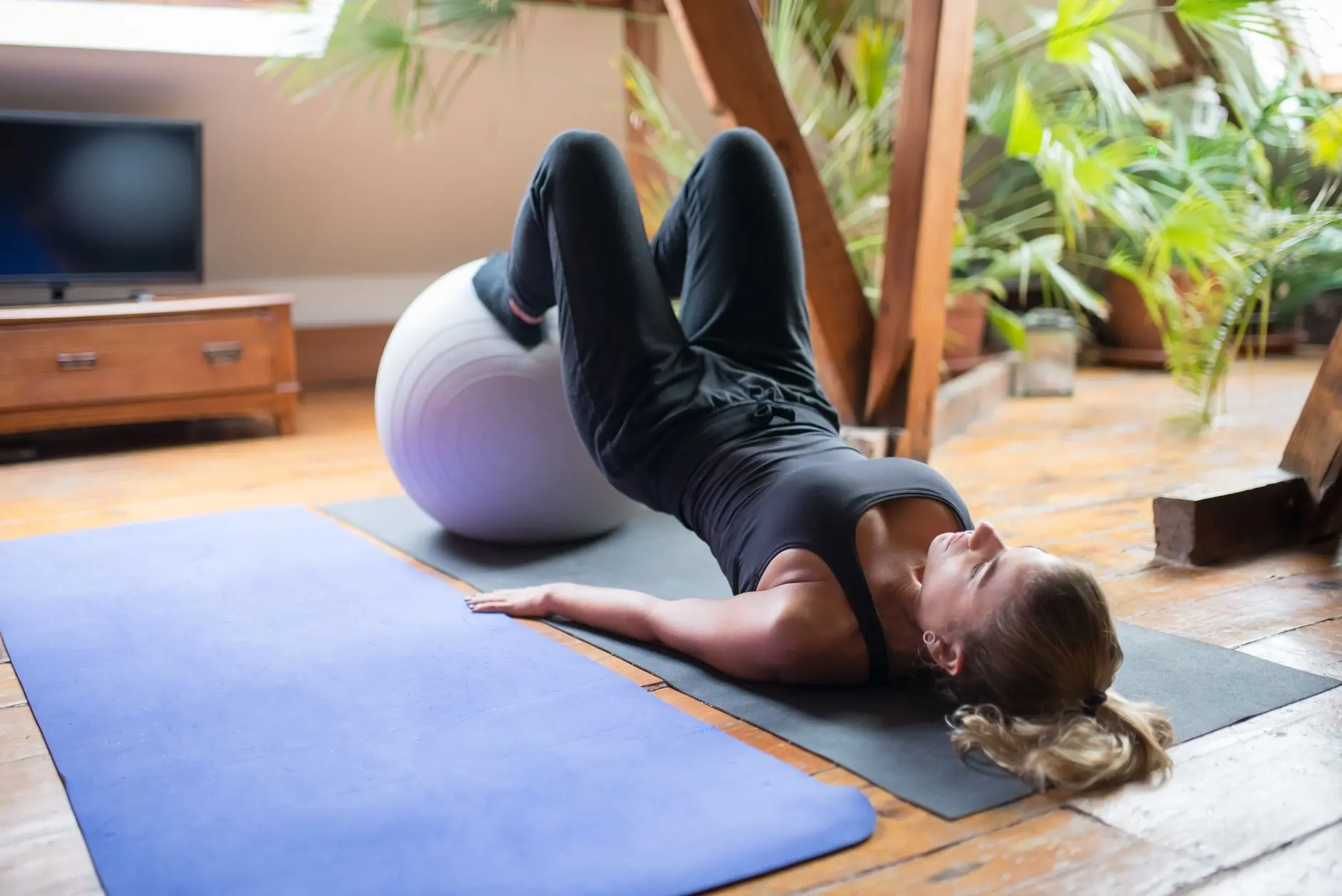
Lie on your back with your heels on top of the ball and knees bent. Press through your heels and lift your hips until your body makes a straight line from shoulders to knees. Hold for 3 to 5 seconds, then lower slowly. Aim for 8 to 10 reps. Stop if you feel it pinch in the back rather than work the glutes and hamstrings.
Dead bug with a ball hold
Lie on your back and hold the ball up between your raised hands and knees so all four limbs press into it lightly. Keep your lower back flat to the floor and slowly reach your opposite arm and leg out a few inches, then switch. Do 6 to 8 per side. This trains the deep core without bending the spine, which suits an irritated disc.
Supported wall squat
Place the ball between your lower back and a wall, with your feet a step forward. Bend your knees to slide down into a shallow squat, no deeper than a quarter of the way, hold a breath, then press back up. Do 8 to 10 reps. It builds leg and hip strength while the spine stays supported.
Gentle supine decompression
Drape your back over the ball with your feet planted and arms relaxed, letting the spine extend gently for 20 to 30 seconds. Only do this if gentle extension eases your leg symptoms, which is common with disc related sciatica but not true for everyone.
Hamstring and nerve glide
Sit on the ball, straighten one knee with the heel on the floor and toes up, then gently point and flex that foot 10 times to floss the sciatic nerve. Keep it light. This should never reproduce sharp shooting pain down the leg.
Pair the ball with the moves that have stronger evidence
The ball is a supporting player, not the whole show. The approaches with the most support behind them for sciatica are the simple ones. Walking is one: short, frequent, flat walks keep the discs nourished and the nerves gliding, and building up your daily total is an easy way to track progress, which our steps to calories calculator can help with. Stretching has its place too, and our rundown of sciatica stretch exercises pairs neatly with the ball work. For a broader strength base once the sharp pain fades, the progressions in our guide to exercises for low back pain take over.
The point of combining them is simple. Swiss ball exercises for sciatica build the trunk control, walking and nerve glides keep things moving, and stretches ease the tightness that comes from guarding a sore leg.
How long until it helps, and what to track
Set your expectations from the natural course of the condition, not the sales copy. Most sciatica eases over a few weeks to a couple of months whether or not you add a ball, so the honest goal of swiss ball exercises for sciatica is to support that recovery, help you move more comfortably, and lower the chance of the next episode, rather than to switch the pain off.
Track the leg, not just the back. Note how far down your leg the pain travels and how often it shoots, because leg symptoms are what moved in the trials and what tells you a nerve is calming down. If you have done four to six weeks of consistent, gentle work and your leg pain is no better, or is worse, that is your cue to see a physiotherapist or doctor rather than pile on more reps. You can find the rest of our evidence based guides in one place on our back pain hub.
Frequently asked questions
Are swiss ball exercises for sciatica safe during a flare-up?
They can be, as long as you keep them gentle and let your symptoms guide you. During an acute flare, stick to seated pelvic tilts and small, slow movements, and avoid anything that sends pain further down your leg. If you have numbness around the saddle area or any loss of bladder or bowel control, stop and seek urgent care instead of exercising.
What size exercise ball is best for sciatica?
Choose a ball that lets you sit with your hips level with or slightly above your knees and your thighs roughly parallel to the floor. As a rough guide, that is a 55 cm ball up to about 5 foot 4 and a 65 cm ball between 5 foot 5 and 5 foot 10. A slightly under inflated ball is more stable while your pain is settling.
Can sitting on a Swiss ball instead of a chair cure sciatica?
No. In lab testing, simply sitting or marching on a ball produced the lowest muscle activity of any ball exercise, so passive sitting does very little. Swapping your chair for a ball may nudge you to move a bit more, but it is not a treatment, and it can add discomfort if you slump into it for hours.
How often should I do these exercises?
Most people do better with short daily sessions of 10 to 15 minutes than with long, occasional workouts. Consistency matters more than intensity with nerve related pain. Build up slowly, and give yourself four to six weeks of regular practice before you judge whether it is helping.
Sources
- Sciatica: a review of history, epidemiology, pathogenesis, and the role of epidural steroid injection in management. British Journal of Anaesthesia, 2007
- Advice to Stay Active or Structured Exercise in the Management of Sciatica: A Systematic Review and Meta-analysis. Spine, 2015
- Core muscle activation during Swiss ball and traditional abdominal exercises. Journal of Orthopaedic and Sports Physical Therapy, 2010
- Sciatica. New England Journal of Medicine, 2015
This article is general health information for adults and not medical advice. It does not know your history, your medication or your results. For a decision about your own health, talk to a doctor or another qualified clinician who does.