


If you are reading how to support a partner with depression, you have probably already tried the obvious things: cheering them up, planning a nice day out, reminding them of everything they have to be grateful for. None of it worked, and you are starting to wonder if you are doing it wrong. You are not. Depression does not answer to logic or love the way a bad mood does, and the gap between what feels helpful and what actually helps is where most partners get stuck.
This guide stays with the evidence: what research shows helps, what to say instead of the lines that make things worse, when to step in hard, and how to carry this without wrecking your own health along the way. That last part matters more than most articles admit, especially if you are a woman in your forties already running low on sleep and steady hormones.
Depression is a medical condition, not a mood you can love away

Depression is common, and you are not the only couple living with it. The World Health Organization estimates that 5.2% of adults have depression, and it is about 1.5 times more common in women than in men, affecting roughly 322 million people worldwide. The same fact sheet reports that in high-income countries only about one in three people with depression get treatment. So if your partner is struggling and has not seen anyone, that is the norm, not a personal failing.
The first rule in how to support a partner with depression is to treat it as an illness rather than an attitude. It blunts pleasure, drains energy, disturbs sleep and bends thinking toward the bleak, and none of that is something a person can simply decide to stop. Telling a depressed partner to think positive is like telling someone with a broken ankle to walk it off. If you want the longer view on what does and does not have evidence behind it, our guide to natural remedies for depression and anxiety lays out which options are backed by research and which are wishful thinking.
Women are also more likely to carry this twice over, living with their own higher baseline risk while supporting a partner through his or hers. If that is you, the advice here works in both directions at once.
How to support a partner with depression in ways that work

The most studied self-help approach for depression is behavioral activation: gently rebuilding small, rewarding activities even when the motivation for them is gone. In the COBRA trial, researchers found behavioral activation worked about as well as cognitive behavioral therapy, cost roughly 20% less, and could be delivered by junior mental health workers rather than specialists. The practical point for you is that the active ingredient is re-engagement with ordinary life, and a partner is well placed to help with that: a short walk, a meal cooked together, a ten-minute errand. Make it a gentle invitation, not a demand, and a smaller ask than you think they can manage.
One caution: do the activity with them, not for them. If you take over every task and chore, you remove the small wins that behavioral activation runs on, and you drift toward smothering. Lower the barrier, then let them take the step.
Movement itself is one of the better-supported tools. An umbrella review of 97 systematic reviews covering more than 128,000 people found physical activity had a medium effect on depression symptoms, with a median effect size of about 0.43, and higher-intensity activity tended to help more. You do not need to turn your partner into a runner. Walking together most days counts, and it gives you both a reason to leave the house.
Sleep is the other lever. Disrupted sleep is one of depression’s core symptoms, and a ragged schedule feeds low mood in both of you. Keeping wake-up times steady does more than most people expect; our sleep calculator can map a realistic bedtime around the hour your partner actually has to be up.
What to say, and what to stop saying

How you talk to a depressed partner is not just etiquette. It has measurable weight. A classic meta-analysis of expressed emotion, the mix of criticism, hostility and emotional over-involvement in a household, found it was a reliable predictor of relapse, and the effect was actually stronger for mood disorders than for schizophrenia. In plain terms, steady warmth and low criticism are not soft extras. They are part of the treatment environment.
That does not mean walking on eggshells. It means dropping a few specific habits. Lines like snap out of it, others have it worse, or you have nothing to be depressed about all land as blame, and a depressed brain is already generating plenty of that on its own. So does the opposite move, hovering and managing every hour of their day, which the same research on over-involvement warns against.
Useful things to say are shorter and less clever than you expect:
- I can see you are having a hard time, and I am not going anywhere.
- What would actually help right now, and what would make it worse?
- I am going for a walk at six. Come if you want, no pressure either way.
- Do you want me to just listen, or do you want ideas?
The last one is the quiet workhorse. Most of the time a depressed partner needs a witness, not a fixer, and asking first saves you from solving a problem they only wanted to say out loud.
When to push for professional help, and how
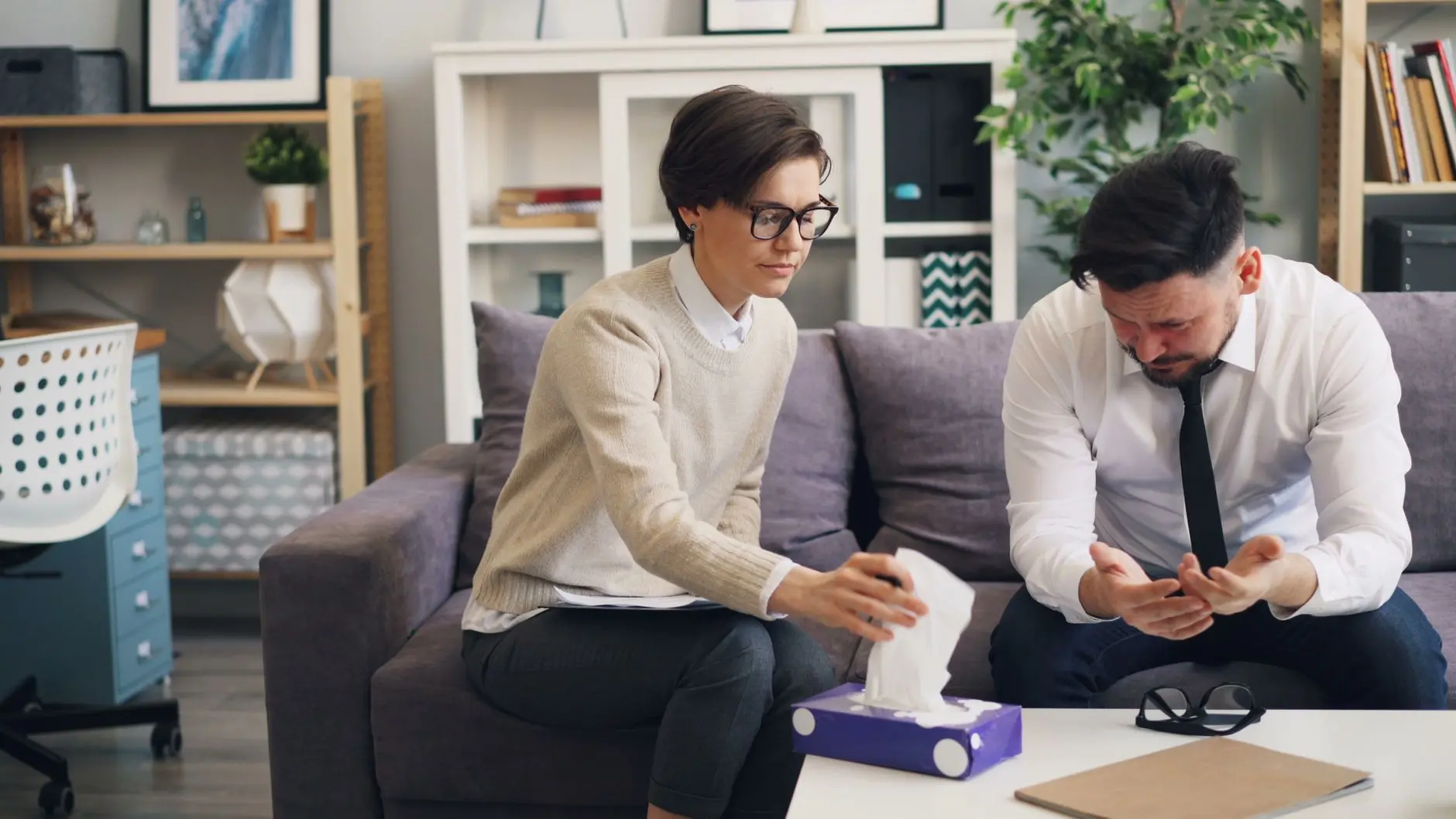
Support from a partner is not a substitute for treatment, and the gap is wide: the WHO figure above means most people with depression are getting no professional care at all. A large part of how to support a partner with depression is accepting that your job is not to be the therapist. It is to lower the barrier to one.
Offer the concrete next step rather than the abstract one. Booking the doctor’s appointment, driving them to it, or sitting in the waiting room removes the friction that depression makes enormous. If medication is already prescribed, steady help staying consistent with it matters more than any pep talk. Avoid ultimatums; pressure tends to raise the exact criticism and over-involvement the relapse research flags.
It also helps to learn how the treatment works so you are not alarmed by its pace. Antidepressants often take a few weeks before they do much, and the early days can bring side effects before any lift in mood, which is when people quit. Knowing that in advance lets you hold steady instead of reading the delay as failure.
The relationship itself can be part of the treatment. A Cochrane review of couple therapy for depression found it appeared about as effective as individual psychotherapy for easing depressive symptoms, though the authors rated the evidence as low quality and called for better trials. It sits in several treatment guidelines, and it is worth raising when the depression and the relationship strain are clearly feeding each other.
Warning signs you cannot wait on
Some situations are not about patience. Depression can be fatal: the WHO records about 727,000 suicide deaths in 2021, and suicide is the third leading cause of death among people aged 15 to 29. Treat direct talk of dying, giving possessions away, a sudden calm after a long low spell, or any researching of methods as emergencies, not moods.
If you think your partner is in immediate danger, do not leave them alone, remove access to anything they could use to harm themselves, and get help now. In the United States you can call or text 988, the Suicide and Crisis Lifeline, which is free and runs around the clock, or go to the nearest emergency room. Asking someone directly whether they are thinking about suicide does not plant the idea; it opens a door.
If you are not sure how serious things are, you do not have to make that call alone. A crisis line will talk it through with you, the supporter, even when your partner will not pick up the phone themselves.
Protect your own health while you do this
You cannot pour steady support from an empty tank, and the partner role carries a real load that most guides skip. If you find yourself feeling responsible for curing them, or arranging your whole day around their mood, that is worth watching. Our piece on signs of codependency in women covers the patterns that turn support into self-erasure, and why taking charge of another adult’s recovery tends to help no one.
Your nervous system takes the hits too. Learning to notice and settle your own stress response keeps you from matching their low mood or snapping under it; our guide to managing emotional triggers is a practical place to start. And guard your sleep, because a depressed partner’s broken nights become yours, and running a household on no rest is its own slow damage. If midlife is already stealing your sleep, getting better deep sleep is not a luxury here, it is maintenance.
Keep one honest fact at the center of how to support a partner with depression: you cannot fix this for them. Even the best first-line treatments do not work for everyone, and recovery from depression is rarely a straight line. What you can do is stay, keep the home warm and low-pressure, help them reach real care, and protect yourself well enough to still be standing when they come back up. That is not a small thing. It is most of the job.
Frequently asked questions
Can you help a partner with depression who refuses treatment?
Yes, within limits. You cannot force an adult into therapy, but you can keep the door open, name what you see without blame, and make the first step as small as possible, such as offering to book and attend one doctor’s appointment. Keep supporting the basics of sleep, movement and routine in the meantime, and get professional advice yourself if their refusal continues or their safety is at risk.
What should you never say to a partner with depression?
Avoid anything that reads as blame or minimizing: snap out of it, others have it worse, you have nothing to be sad about, or just think positive. Research on expressed emotion links household criticism and hostility to higher relapse rates. Replace those lines with steady, low-pressure messages that you are staying and that you want to know what would actually help.
Is it normal to feel exhausted supporting a depressed partner?
Completely. Partners of people with depression carry a heavy and often invisible load, and burnout, resentment and your own low mood are common. That is a signal to protect your sleep, keep your own friendships and interests alive, and consider your own therapy or a support group. Looking after yourself is part of supporting them, not a betrayal of it.
Does couples therapy help when one partner is depressed?
It can. A Cochrane review found couple therapy appeared about as effective as individual psychotherapy for easing depression symptoms, though the evidence quality was low. It is most worth considering when relationship strain and the depression are clearly feeding each other. It does not replace medical assessment, especially for moderate or severe depression.
When does a partner’s depression become an emergency?
Treat any talk of wanting to die, making plans, giving away possessions, or a sudden calm after a deep low as an emergency. Do not leave them alone, remove access to means of harm, and get help immediately. In the United States, call or text the 988 Suicide and Crisis Lifeline, or go to the nearest emergency room.
Sources
- Depressive disorder (depression) fact sheet. World Health Organization, 2023
- Cost and Outcome of Behavioural Activation versus Cognitive Behavioural Therapy for Depression (COBRA): a randomised, controlled, non-inferiority trial. The Lancet, 2016
- Effectiveness of physical activity interventions for improving depression, anxiety and distress: an overview of systematic reviews. British Journal of Sports Medicine, 2023
- Expressed emotion and psychiatric relapse: a meta-analysis. Archives of General Psychiatry, 1998
- Couple therapy for depression. Cochrane Database of Systematic Reviews, 2018
This article is general health information for adults and not medical advice. It does not know your history, your medication or your results. For a decision about your own health, talk to a doctor or another qualified clinician who does.


